Why did I choose Goldfish as my food for this assignment?
I chose to write about goldfish simply because that was the snack I reached for when I went to eat before starting this assignment. I was originally going to do peanut butter after watching my dad eat a peanut butter sandwich for lunch. I looked at the packaging and saw that Goldfish had more than 6 ingredients and met the requirements for the assignment.
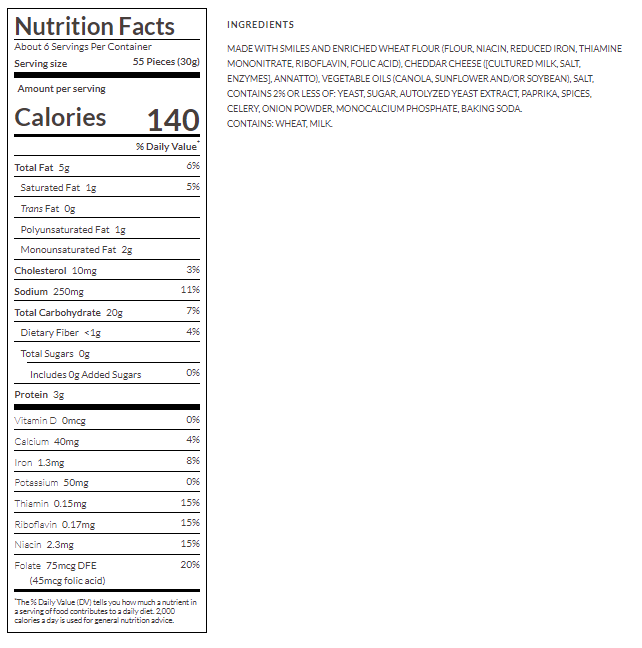
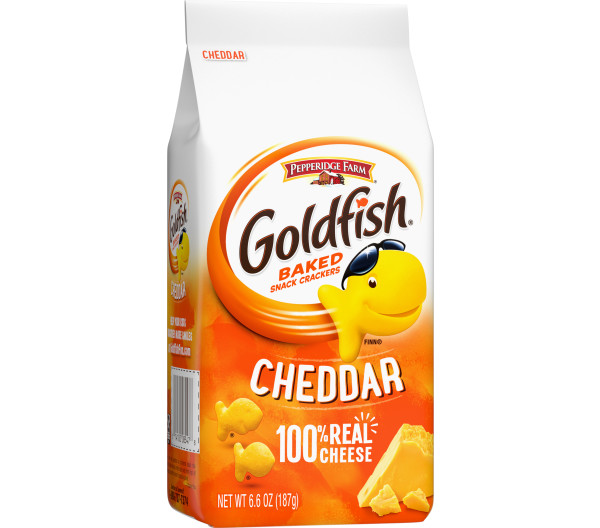
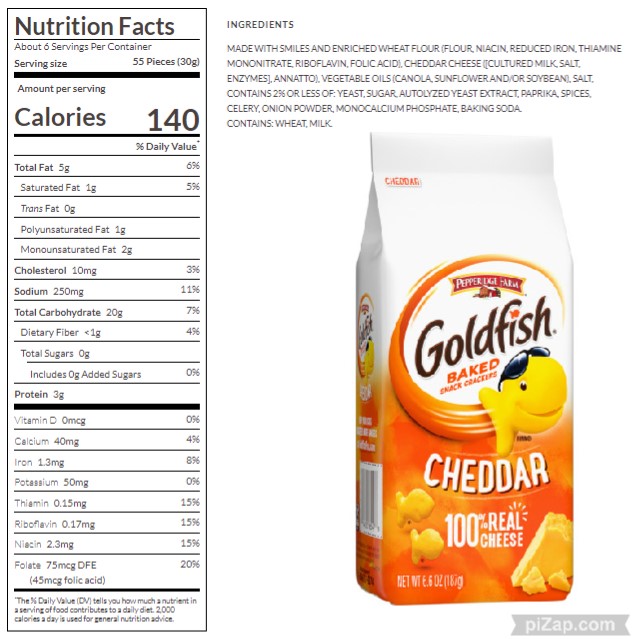
Nutrition Label and Product Image from Pepperidgefarm.com
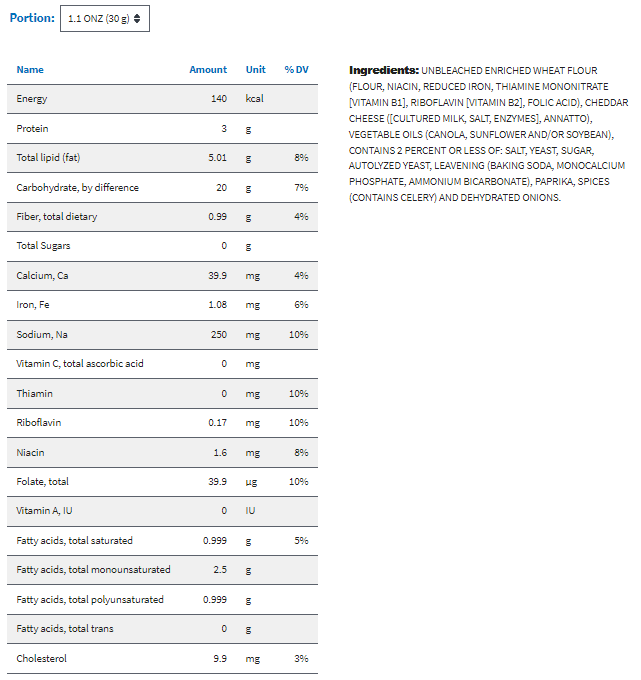
Nutrition Report from the USDA Database

My Questions About The Nutrition Label and Ingredients
In the Nutrition panel, you can see that there is “0.15 mg” of Thiamin adding to 15% of the total protein. However, in the USDA nutrition listing, Thiamin’s total amount in the product is 0 mg, yet it has a 10% rating for the “%DV” (percent daily value) column has the same 10% daily value rating has Thiamin. Why is the daily value amount of thiamin 10% according to the USDA despite having a total of 0mg in the product according to the website? I can understand having some variation in the daily value percentage between the two sites being a result of different measuring scales, but how can you get 10% daily value from nothing? Why is that 0.02 difference in milligrams not included or mentioned on the USDA site? Also, what is the point of adding Paprika (which I am pretty sure is a spice) to a product designed to taste like cheese? Even if it makes up less than 2% of the product, what does paprika add to the product flavor? And regarding the serving size, does Pepperidge Farm weigh out 6 scoops of 30 grams of goldfish per package to know that there are around 6 servings per container? What is the process behind determining how many crackers would make up a ‘serving’? How were the calories (in this product and in general) calculated? I’m guessing the percent daily value would be calculated by dividing 140 calories (which is one serving) into 2000 calories as mentioned at the bottom of the nutrition label, but then how is a serving calculated?
Evidence of What I’m Referring To:

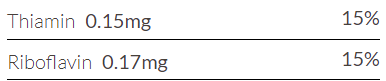
A Recreation Of The SmartFood Example I Tried To Replicate To Include Both The Product Image And The Nutrition Label
Part 2
What is protein?
Proteins are long chains of amino acids. They are crucial in helping the human body carry out simple functions such as converting digested food into energy. Protein can be found in both plants and animals, hence why humans need to eat foods like fish and meat to acquire those proteins as those foods have essential amino acids that do not naturally form inside the human body. There are 9 amino acids out of the 20 naturally occuring amino acids that the human body can not make, thus the need to eat foods having those amino acids. Proteins are found in pretty much every cell in the human body and has an impact on things such as repairing cells or hair growth.
How much protein is this food item contributing to the % DV? What does that mean? In your answer, report the % DV for protein – even if your food item doesn’t contain protein
Goldfish contributes 3 grams of protein to the percent daily value. The FDA recommends that each person should eat around 50 grams of protein per day. Goldfish contributing 3 grams so, doing some math (first doing 3/50 then multiplying that answer by 100), I know that of the 50 grams of protein the FDA reccommends a person to consume on a daily basis, a person can get 6% of those grams by consuming goldfish. So in other words, this means that 6% of the recommended amount of protein (50 grams) to be consumed per day to help reach the daily value can be obtained by eating 55 pieces of goldfish (which is the serving size on the package). There are 4 calories per gram of protein. So, 12 calories of protein can be consumed by eating goldfish which then means that in order to “meet” the recommended requirement of consuming 2,000 calories per day, only 1,988 more calories would need to be consumed that day to meet that total number.
What ingredients in your food item are contributing the protein? If you don’t know what an ingredient is, you can look each ingredient up individually on the https://fdc.nal.usda.gov/Links to an external site. database for a list of the macronutrients.
I’m not sure if I’m doing this right, but according to the USDA, the “enriched wheat flour” bleached or unbleached both contain grams of protein. Seeing as vegetable oil is a fat, both the “enriched white flour” (bleached or unbleached depending on where you look if it’s on the Pepperidge Farm website or if you are looking at the USDA), and the cheddar cheese are the ingredients that are contributing the protein.
How many calories in your food item are due to protein? How can you tell? Please explain how you calculated the protein calories. Or if your food item contains no protein, explain how you would hypothetically calculate protein calories.
Multiplying 3 (the total number of grams) by 4 (how many grams are in a protein calorie) I get a total of 12 calories. So, 12 of the 140 calories in Goldfish is due to protein.
What is Fat?
Fat is a lipid. It is a triglyceride composed of three fatty acids. There are different types of fats and their chemical structure and the presence of double bonds determines it’s structure and how well it will bond with other molecules. It is hydrophillic.
How much fat is this food item contributing to the % DV? What does that mean? In your answer, report the % DV for fat – even if your food item doesn’t contain fat.
In total, goldfish has 5 grams of total fat, adding to 6% of the daily value. There are around 9 calories per gram of fat. This means that in one serving, goldfish will contribute 54 calories to the consumed daily value just from the total amount of fat. The slide says that, if doing a 2,000 calorie diet, no more than 600 (which is 30% of 2,000) calories can come from fat per day. If I was to do that diet and eat goldfish, then I can consume 546 calories of fat the rest of the day before reaching that 30%. According to the label, goldfish contributes 6% to the DV and 8% according to the USDA.
However, if I do (54/2000) x 100, I get a total of 2.7%, so I’m not sure what is right. 54 divided by 600 then multiplied by 100 yields 9% which is closer to what the USDA said the %DV is and I’m just confused.
What ingredients in your food item are contributing the fat? If you don’t know what an ingredient is, you can look each ingredient up individually on the https://fdc.nal.usda.gov/Links to an external site. database for a list of the macronutrients.
The vegetable oils all contribute to the fat in the goldfish. The oils used are said to be canola oil along with “sunflower and/or soybean” oil.
What types of Fats does your food item contain? Consider Fatty acids, total saturated, Fatty acids, total monounsaturated , Fatty acids, total polyunsaturated and Fatty acids, total trans. What are these different types of fat and why should we care? Answer these questions even if your food item doesn’t contain fat.
Despite the nutrition label not making sense for how 6 grams of fat came from 5 grams of fat (because the total fat amount is different than what the total grams of the listed fat amounts are), goldfish contains Saturated fat, Polyunsaturated fat, and Monounsaturated fat.
There are a couple of different types of fats. There are four main types: saturated fat, trans fat, polyunsaturated fat, and monosaturated fat. Saturated fats contain fatty acid chains that are straight single bonded. They are able to be more tightly compacted and have a more solid structure, unlike unsaturated fats. A monounsaturated fat contains one double bond between carbons in the fatty acid chain. A polyunsaturated fat contains more than one C-C double bond. The double bonds also affect the orientation of the chain, how it bonds with other molecules, and effects it’s melting point. Trans fats come from double bonds causes the chain formation to switch and have hydrogens on the opposite side of the unlike a ‘regular’ fatty acid chain. Trans fats are more likely to be more shelf stable and are also more likely to cause cardiovascular disease. Their shape is similar to other unsaturated fats and can thus bond with other unsaturated fats. At room temperature, unsaturated and polyunsaturated fats are liquid.
How many calories in your food item are due to fat? How can you tell? Please explain how you calculated the fat calories. Or if your food item contains no fat, explain how you would hypothetically calculate fat calories.
Like I said earlier, per gram of fat equats to approximately 9 calories. Multiplying that number by the total grams of fat (9), I get 54 calories. That means, of the 140 calories in Goldfish, 54 of them are due to fat.
Part 3
Additives:Autolyzed Yeast Extract, Monocalcium Phosphate, spices, onion powder, annatto, baking soda, thiamine mononitrate, folic acid
| Additive | Purpose |
| Autolyzed Yeast Extract | I think it coats the outside of the outside of the crackers and adds some flavor to it (my source) |
| Monocalcium Phosphate | An acid to be used with baking soda to get it to release C02. (foodadditives.net) |
| Spices | Herbs that give the food some extra flavor |
| Onion Powder | Powdered/chopped onion used as an extra spice |
| Annatto | A substitute for caramel color to I guess give the goldfish it’s orange color. |
| Baking Soda | Most likely gave the cracker it’s hollow interior as it produces gas in the over |
| Thiamine Mononitrate | According to foodinsight.org, and the NIH, thiamine mononitrate is important in the process of the body maintaining, digesting, and gaining energy from the food. |
| Folic Acid | Folic acid is “a form of folate”, which plays a role in cell division and DNA/genetic material creation (NIH) |
Minerals
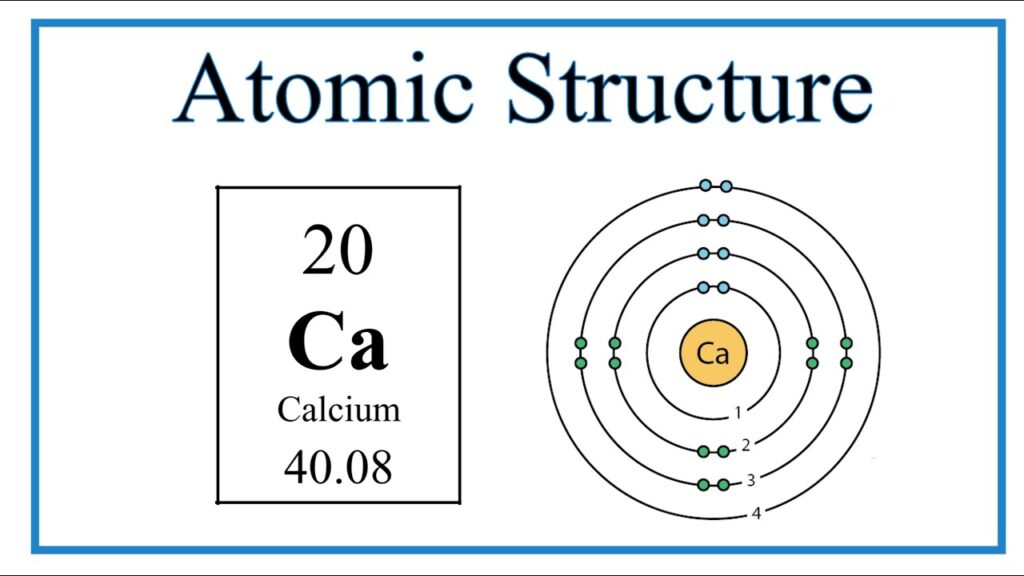
Calcium: Calcium is the mineral that is the “most abundant” in the body. It’s important in keeping bodily tissues strong and plays a role in mediating “blood vessel contraction and dilation, muscle function, blood clotting, nerve transmission, and hormonal secretion” (NIH.gov). Having low calcium leaves the body at risk for osteoporosis, which is basically when the bones become weaker due to becoming more porous (pubchem.gov). Calcium is a +2 cation.
Image via Wayne Breslyn
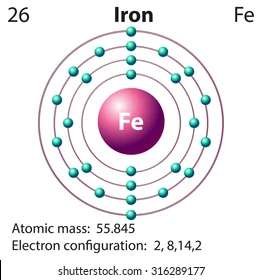
Iron: Iron plays a part in forming the protein hemoglobin, which is responsible for transporting oxygen in the blood between the lungs and tissues. It is important hormone synthesization, neurological development, cellular functioning, and physical growth (NIH.gov). Having low iron may result in “iron-deficiency anemia” (pubchem.gov).
Iron: Iron plays a part in forming the protein hemoglobin, which is responsible for transporting oxygen in the blood between the lungs and tissues. It is important hormone synthesization, neurological development, cellular functioning, and physical growth (NIH.gov). Having low iron may result in “iron-deficiency anemia” (pubchem.gov).
Image via ShutterStock
Carbohydrates (Use text and chemically accurate images to represent this information)
(a) Identify the ingredients that are contributing sugars. What types of sugar are likely to be present? From which ingredients?
So both of the nutrition labels say that there are zero grams of sugar in the product. However, the ingredients list says that there is less than 2% of sugar in Goldfish, which I guess is the only ingredient contributing sugar to the Goldfish.
(b) Identify the ingredients that are contributing fiber. What types of fiber are likely present? Soluble vs insoluble? What ingredients are contributing what?
Both labels say there is around 1 gram of dietary fiber in Goldfish. Because they are “dietary”, I am guessing they are soluble because goldfish tends to turn to mush when it comes in contact with water or saliva. It’s able to dissolve. Not fully, but Goldfish is soluble to an extent. Soybean and the rest of the vegetables that are in the vegetable oils in goldfish, I believe, contribute to forming the soluble fibers. (I used Mayo Clinic as a reference).
(c) Don’t forget about the starch! Determine the grams of starch present in your food item. The starch is total carbs – sugar – fiber = starch. In other words, subtract sugar and fiber from the total carbs to get the starch.
20g – 0g – 1g = 19 grams of starch
(d) Perform a calculation of the calories from carbohydrate per serving. Make sure to account for fiber.
20-1= 19
19 x 4 = 76 carbohydrate calories (80 without subtracting the fiber)
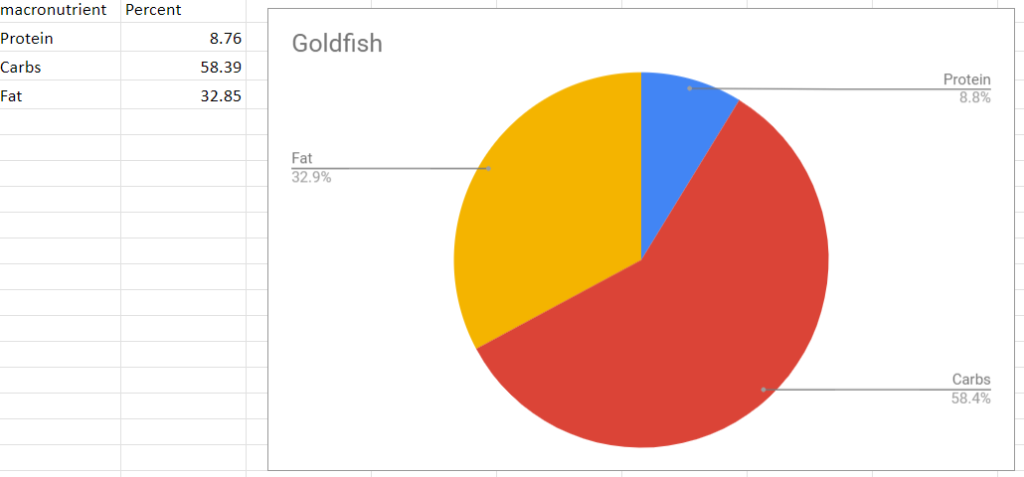
5. Combine your carbohydrate calories calculation with earlier calculations on fat and protein to provide a complete analysis of the calories for your food item which includes a pie chart.
Protein calculations: 3 x 4 = 12
Fats: 5 x 9 = 45
According to the food label, there are around 140 calories per serving.
Calorie calculation without subtracting the 1 gram of fiber: 80 calories from carbs + 12 calories from protein + 45 calories from fat = 137 calories
Calorie calulation with the subtraction: 76 calories from carbs + 12 calories from protein + 45 calories from fat = 133 calories
The calculation I did without subtracting the fiber was the closest to 140 calories, so 137 calories is the correct amount of calories (if I am phrasing that right).
Percent Macronutrient Calculations
80 calories from carb: (80/137)*100 = 58.39%
45 calories from fat: (45/137)*100 = 32.85%
12 calories from protein: (12/137)*100 = 8.76%
58.39% + 32.85% + 8.76% = 100%!!! (I’m so happy the math worked out!)
6. Now that you have learned about your food item, revisit what you wrote in FoF – Part 1 and answer the question (Something you “did not understand about the nutrition label”) you had ~8 weeks ago.
So…I had a lot of questions back in June. While I think I can answer some, I don’t think I can answer all of them. The difference in the amount of thiamin and riboflavin between each nutrition label was due to a difference in how each ingredient was labeled between the USDA and Pepperidge Farms. The calories were calculated by multiplying the number of grams by the macronutrient’s respective calorie conversion number (i.e. 4 for protein and carbs and 9 for fats). You also might need to subtract the amount of fiber just in case the total calorie amount on the box was calculated including however many calories the fiber would give you. I think the daily value percentage is calculated by diving the macronutrient into however many calories the FDA reccommends a person on a 2000 calorie diet should consume a daily basis before multiplying that number by 100. I don’t think I can explain how Pepperidge determines the serving size and the calories per serving size or answer any of the rest of my questions.